Semaglutide vs Tirzepatide: 5 Differences That Matter
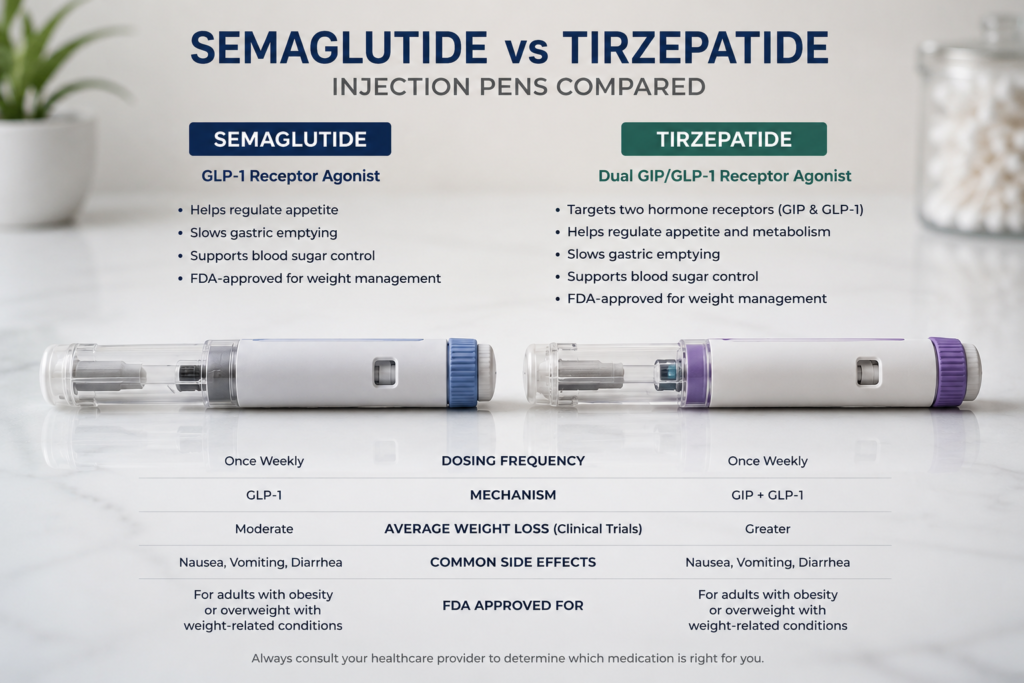
Semaglutide vs tirzepatide is the first question most people ask once they start looking at medical weight loss, and the honest answer is that neither one is “better.” They’re different tools, and the right one depends on your health history, your tolerance for side effects, and your budget. Here’s the plain-English version of how a physician actually thinks through the choice.
How Each Medication Works
Both belong to the same family of medications, called GLP-1 receptor agonists. They mimic a hormone your gut releases after eating, which slows stomach emptying, steadies blood sugar, and quiets the constant background noise of appetite. You can read more about how this class works on our GLP-1 treatment options page.
The difference is that semaglutide works on one receptor, GLP-1. Tirzepatide works on two, GLP-1 and GIP. That second receptor is involved in how fat cells store and release energy, and activating both together appears to produce a stronger combined effect.
One receptor versus two is the entire mechanical difference. Everything else flows from it.

What the Studies Actually Show
In published clinical trials, people on semaglutide lost on average around 15% of their body weight. Tirzepatide trials showed averages closer to 21%. A head-to-head comparison published in a peer-reviewed systematic review found tirzepatide produced roughly 50 pounds of average loss versus 33 pounds for semaglutide over a similar period.
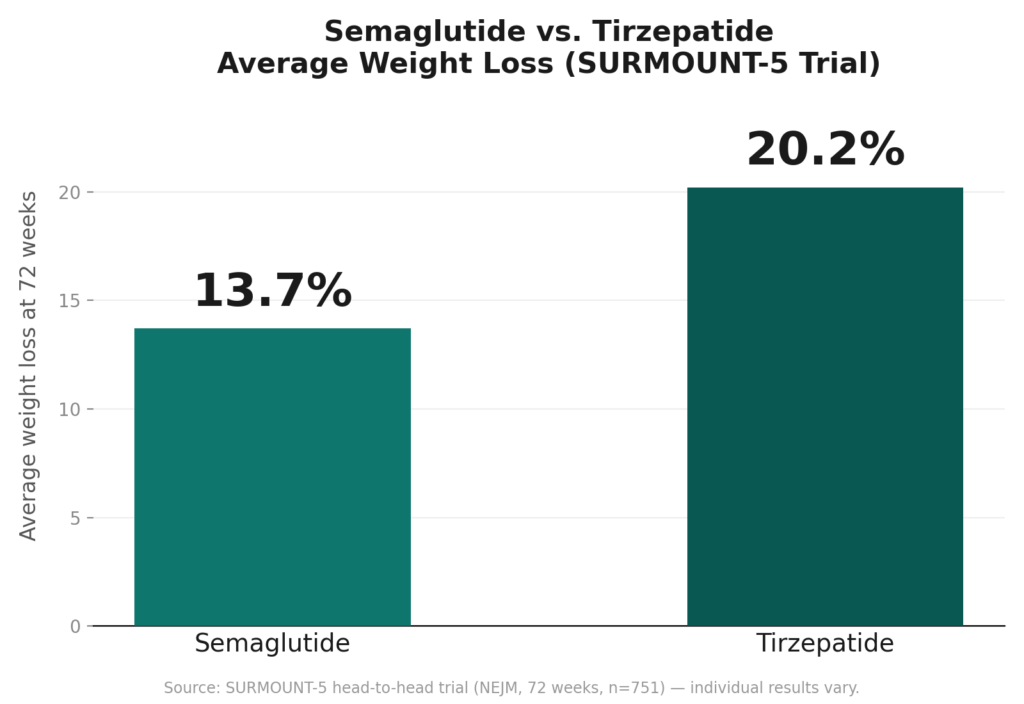
Two important cautions on those numbers. First, they’re averages from trials, not predictions for you. Individual responses vary widely, and some people respond better to semaglutide than to tirzepatide. Second, every one of those trial participants was also making lifestyle changes with medical supervision. The medication was one part of a program, not the whole program.
Side Effects: the Trade-Off Nobody Skips
Both medications share the same core side effects: nausea, constipation, and fatigue, especially during dose increases. Because tirzepatide acts on two receptors, its side effects can run stronger for some people. A slower dose schedule usually manages this, which is one reason dose adjustments should be based on how you’re actually responding rather than a fixed calendar.
Neither medication is appropriate for people with a personal or family history of medullary thyroid cancer, and a history of pancreatitis changes the conversation too. This is exactly what screening lab work is for.
Cost and Availability
Tirzepatide typically costs more, and insurance coverage for weight loss use varies a lot. Semaglutide has been on the market longer and coverage pathways are more established. For some people the practical question isn’t which medication is stronger, it’s which one they can stay on long enough to matter. A medication you stop in month two does less than a medication you can sustain for a year.
How a Physician Actually Chooses
A good program doesn’t start with the medication. It starts with labs, health history, and what you’ve already tried. From there the decision usually falls out fairly naturally: budget and coverage narrow the options, health history rules things in or out, and side effect tolerance gets discovered in the first month and adjusted for. Our semaglutide treatment in Georgetown TX and tirzepatide program pages cover what each looks like in practice.
That’s the real difference between getting a prescription and being in a program. The prescription is identical either way. The adjustment is not.
Frequently Asked Questions
Is tirzepatide just a stronger semaglutide?
No. It’s a different medication that works on an additional receptor. Trial averages favor it for total weight loss, but individual response varies, and stronger average effect also means potentially stronger side effects.
Can you switch from one to the other?
Yes, under medical supervision. People switch in both directions, usually over side effects, cost, or a plateau. Switching requires re-titrating the dose, not swapping pens at the same strength.
Are the compounded versions the same thing?
Not necessarily. The FDA has warned specifically about salt forms of semaglutide, which are not the approved medication. If a price looks dramatically lower than everywhere else, ask exactly what’s in the vial and which pharmacy made it.
How long do you stay on these medications?
It varies by person and goal. What the research is clear on: stopping abruptly with no maintenance plan usually means regaining. An exit plan should exist from day one.
Do these medications work without changing anything else?
They work noticeably less well. Every strong trial result came from medication plus supervision plus lifestyle change. The medication lowers the difficulty. It doesn’t remove the game.
Talk It Through With a Physician
Comparing semaglutide vs tirzepatide on the internet gets you to about 80% of an answer. The last 20% is your labs, your history, and your budget, and that part is a conversation. We offer a free consultation to walk through both options with no obligation to start anything.
This article is for educational purposes only and is not medical advice. Prescription weight loss medications require evaluation by a licensed medical provider. Individual results vary. Talk to a physician about whether any medication is appropriate for you.